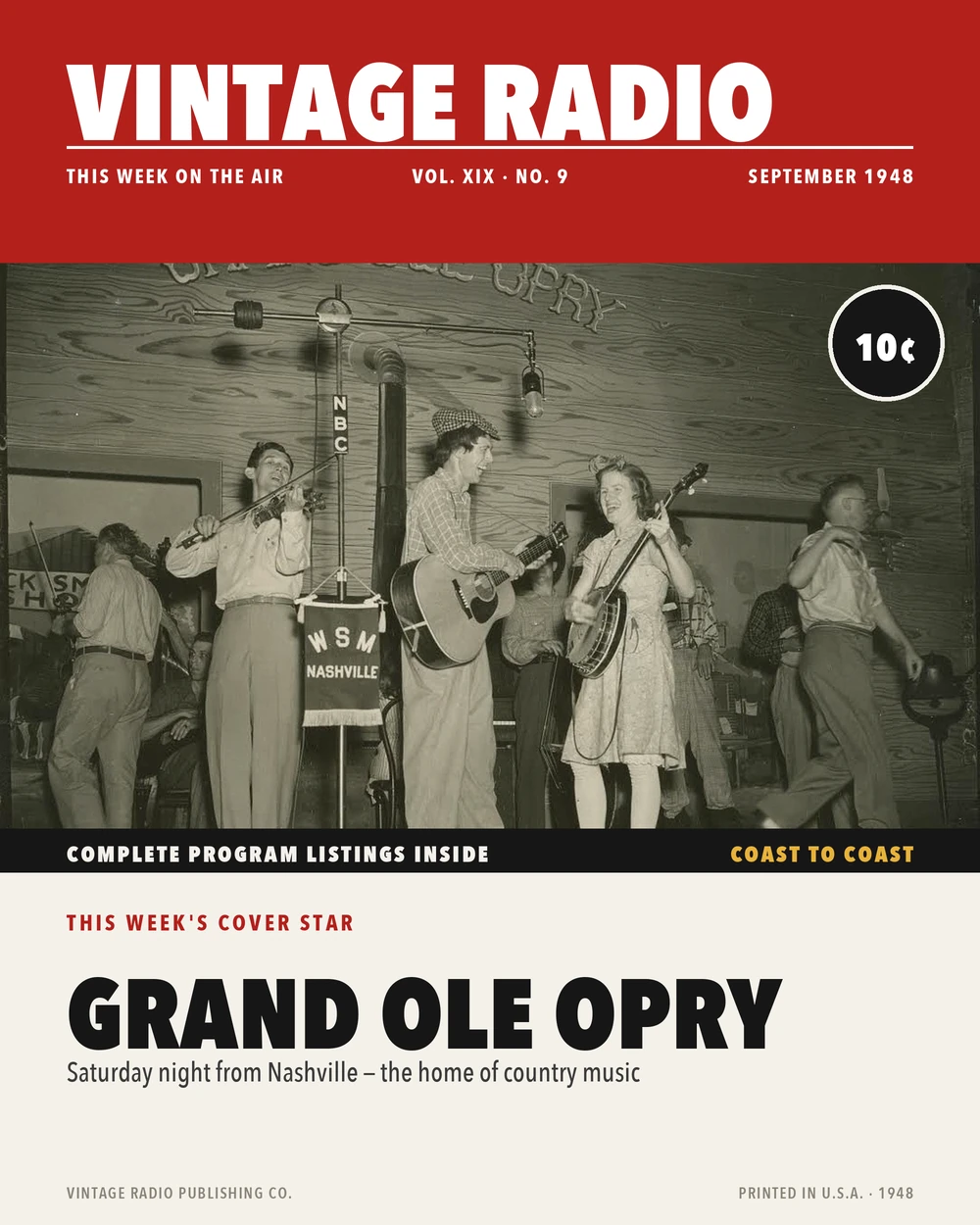
Grand Ole Opry
How It Started
The Grand Ole Opry got its name by accident — or at least by impulse. On the night of December 10, 1927, a feed from the NBC network in New York called the Music Appreciation Hour had just signed off. Its host, Dr. Walter Damrosch, had closed with a musical railroad theme and made a passing reference to "grand opera." When the microphone came back to WSM in Nashville, announcer George Dewey Hay told his audience: "From here on out, folks, it will be nothing but realism of the realest kind. You've been up in the clouds with grand opera: now get down to earth with us in a shindig of grand ole opry!" The name stuck, and what had been operating since November 28, 1925, as WSM's Saturday night barn dance became something with an identity.
Hay's path to Nashville ran through Chicago, Arkansas, and a Memphis newspaper. He had served in the U.S. Army during World War I and then become a reporter for the Memphis Commercial Appeal, where he wrote a humorous column called "Howdy, Judge" — imaginary exchanges between a judge and people charged with petty crimes. That column gave him the on-air nickname "the Solemn Ole Judge," and a 1919 reporting assignment in Mammoth Spring, Arkansas, where he stumbled onto a late-night hoedown with a fiddle player, guitar player, and banjo player, gave him a different kind of idea. By 1924 he was at WLS in Chicago, helping to put together The National Barn Dance, and a Radio Digest poll that year named him the most popular radio announcer in America. WSM in Nashville, newly on the air as of October 5, 1925 — its call letters standing for "We Shield Millions," the slogan of its parent company, the National Life and Accident Insurance Company — hired Hay to direct programming. He arrived in 1925 and found that Dr. Humphrey Bate and his string band had already been playing on the station for about a month.
The first broadcast under Hay's direction featured Uncle Jimmy Thompson, a fiddler Hay had invited to perform. Thompson was approximately 83 years old at the time, had fought in the Civil War, and claimed never to have lost a fiddling competition in his life. His niece accompanied him on piano. The broadcast was originally supposed to run an hour, but Thompson and the banjoist Uncle Dave Macon both felt that an hour wasn't enough of a warmup, and Hay stretched the program to run from 8 p.m. to midnight. That expansion of scope — more time, more acts, more room for whoever showed up — set the tone for how the show would operate for years to come.
Hay's own tenure took a sharp turn in 1930, when he suffered a nervous attack and was replaced as station manager by Harry Stone. Hay continued to host the show, but Stone took the commercial reins, and the early 1930s brought a more deliberate push to package the Opry as a business as well as a broadcast. By 1933, Hay had helped set up a booking agency for Opry performers; some acts were already touring theaters as far away as Iowa. Hay stayed with the show into the 1940s, touring with Opry troupes and turning up at New York's Carnegie Hall in September 1947 for one of his last road appearances. He retired in 1956 and was inducted into the Country Music Hall of Fame in 1966, returning to Nashville one final time for the ceremony.
The Early Cast
The roster of performers in the Opry's first decade reads like a catalog of pre-commercial country music styles. A circa-1930 cast photograph documented in Jack Hurst's book Nashville's Grand Ole Opry included the full complement of acts Hay had assembled: Humphrey Bate's Possum Hunters, Paul Warmack and his Gully-Jumpers, George Wilkerson and the Fruit Jar Drinkers (said to pass around a jar of moonshine between numbers), Arthur Smith and his Dixie Liners, Jack Shook and the Missouri Mountaineers, the Binkley Brothers and their Dixie Clodhoppers, and Kirk and Sam McGee, among others. Kitty Cora Kline played the zither. Fiddler Sid Harkreader appeared. The Vagabonds — Herald Goodman, Dean Upson, and Curt Poulton — handled vocal harmony. Asher and Little Jimmy Sizemore were a father-and-son guitar-and-vocal team. Robert Lunn, billed as the "talking blues boy," performed an endless song in fragments for more than ten years.
Hay had a deliberate hand in shaping the image of these acts. He encouraged performers to dress in overalls and straw hats and gave bands rustic names — Dr. Bate's string orchestra, for example, had been the Augmented String Orchestra before Hay renamed them the Possum Hunters. The comedians Sarie and Sallie (Edna Wilson and Margaret Waters), Jam-up and Honey (Bunny Biggs and Lee Davis Wilds doing blackface routines), and Zeke Clements as the Dixie Yodeler all reflected the variety-show sensibility Hay brought from his vaudeville-adjacent radio background.
The one figure in the circa-1930 photograph who occupied genuinely unusual ground was DeFord Bailey. Born in Smith County, Tennessee, on December 14, 1899, Bailey had been making regular appearances on the program since June 1926 and was the first African American performer on the show. Hay described him as a "wizard" on the harmonica, and it was Bailey's playing — specifically his harmonica train song "Pan American Blues" — that immediately followed the Music Appreciation Hour broadcast on the night Hay coined the name "Grand Ole Opry." Bailey's 1927 recording of "John Henry" was released by RCA in both the "race" series and the "hillbilly" series simultaneously, which said something about the ambiguous position he occupied as a recording artist. He was also listed as the cast "mascot" in some materials of the era — a designation that reflected the racial dynamics of the time with uncomfortable clarity. Bailey was fired by WSM in 1941 during a licensing dispute with ASCAP that prevented stations from broadcasting his registered tunes without incurring steep fines. Hay's 1945 book A Story of the Grand Ole Opry characterized the firing as Bailey refusing to learn new material. Bailey himself, in conversations with his biographer David Morton, said he believed the real reason was to avoid paying him fairly. After leaving the Opry, Bailey operated a shoeshine parlor in Nashville for the rest of his working life.
Uncle Dave Macon, born David Harrison Macon on October 7, 1870, in Smartt Station, Tennessee, joined the Opry in 1926 and became its first major star. Hay nicknamed him "The Dixie Dewdrop." Macon was known for his chin whiskers, his gold teeth, his gates-ajar collar, and his open-backed Gibson banjo, and he performed with a showmanship rooted in the medicine show and minstrel traditions. Music historian Charles Wolfe wrote of Macon: "If people call yodelling Jimmie Rodgers the father of country music, then Uncle Dave must certainly be the grandfather of country music." Macon's last Opry performance took place at the Ryman Auditorium on March 1, 1952; he fell ill at the end of his set, was admitted to the hospital the next day, and died on March 22, 1952, at Rutherford County Hospital in Murfreesboro, Tennessee. More than 5,000 people attended his funeral. His pallbearers were George Hay, Kirk McGee, Roy Acuff, and Bill Monroe.
WSM, the Signal, and the Growing Audience
WSM broadcast at 50,000 watts and operated what the station described as the world's largest radio tower. In the show's early years, the signal could reach into 30 states, and on a good night could be heard a thousand miles away. That range meant the Opry had a national audience long before it had a national network deal. Fan mail came from across the country, and the barn-dance format traveled with the signal.
The live audience grew with the radio audience. By 1934 the program had outgrown the 500-seat studio WSM had built specifically for broadcasts, and the show moved to the Hillsboro Theatre — now the Belcourt Theatre — in October of that year. By June 1936 it had moved again, to the Dixie Tabernacle at 410 Fatherland Street in East Nashville: a religious revival house with 3,500 wooden bench seats, sawdust floors, and no dressing rooms, which Jack Hurst described as having "a couple of thousand crude, splintery bench seats." Three years later, in July 1939, the show moved to the War Memorial Auditorium, which held 2,200 seats. An admission charge of 25 cents was introduced there partly to help manage the crowds. The Opry was eventually asked to leave the War Memorial after reports of audience members damaging the upholstery.
On June 5, 1943, the show began broadcasting from the Ryman Auditorium, originally the Union Gospel Tabernacle, built in 1892 by riverboat captain Thomas Ryman. The Ryman seated 3,600, and Ryman manager Lula Naff brought the Opry in after the War Memorial situation. Every show at the Ryman sold out; hundreds of fans were often turned away at the door. The Opry stayed at the Ryman for more than three decades. WSM eventually purchased the building on September 27, 1963, for $207,500.
Going National: The NBC Years
R. J. Reynolds brought a 30-minute sponsored segment to NBC starting on October 14, 1939, with Prince Albert Tobacco as the underwriter — giving the program what became known as the Prince Albert Show. The NBC half-hour aired Saturdays at 10:30 p.m. until late 1951, then shifted to 9:30. For the first four years after the NBC debut, network coverage was uneven; big-city affiliates resisted carrying country and hillbilly music, and the show's reach was patchy. In early 1943, Ralston Purina began sponsoring a separate Opry segment for NBC stations in the south and southwest. Nine months later, in October 1943, NBC put the show on its full network with Prince Albert as the sole sponsor.
The network segment had its own host: Whitey Ford, known as "the Duke of Paducah," a veteran of big-time entertainment and a former National Barn Dance player from WLS Chicago. Louie Buck served as announcer. Direction of the NBC segment rotated among Jack Stapp, Ott Devine, and Kenneth W. MacGregor, with Vito Pellettieri as stage manager. The network required a script, but it was, by all accounts, followed loosely.
Roy Acuff served as the first host of the Prince Albert segment, beginning in 1939, though he had spent three years trying to get on the Opry before finally appearing in 1938. Red Foley took over as host from 1946 to 1954. Acuff had left the show briefly in 1946 following a dispute with management. During the same period, Acuff and songwriter Fred Rose founded Acuff-Rose Music in 1942 — the first major Nashville-based country music publishing company, which later brought in Hank Williams, Roy Orbison, and the Everly Brothers. Acuff became the first living inductee into the Country Music Hall of Fame in 1962.
The NBC segment ran until December 28, 1957. For much of its run, it aired one hour after The National Barn Dance on the same network — the Chicago program that had originally inspired Hay's vision for the Opry.
The Performers Who Defined the Later Era
The acts that filled the later Opry roster — from the late 1930s through the 1950s — included names that would go on to define country music as a commercial genre. Roy Acuff and his Smoky Mountain Boys, Bill Monroe, Ernest Tubb, Eddy Arnold, Hank Williams, the Carter Sisters, Carl Smith, George Morgan, Pee Wee King, and Rod Brasfield all appeared on the program during this era. "Cousin" Minnie Pearl — standup comedienne, perpetual hat-with-price-tag, teller of tales from the fictional Grinders Switch, Tennessee — became one of the most recognizable figures in the show's history. Doyle and Teddy Wilburn, child prodigies, were inducted as Opry members in 1940 at ages ten and nine — among the youngest in the show's history — though their membership was suspended until 1956 to comply with child labor laws.
Several of the arrivals came with moments attached. Hank Williams made his Opry debut on June 11, 1949, performing "Lovesick Blues" and receiving six encores — a record for the program. He was fired on August 11, 1952, by Opry manager Jim Denny following repeated missed shows tied to alcohol abuse. On October 2, 1954, a 19-year-old Elvis Presley made his first and only Opry appearance, performing a rockabilly version of Bill Monroe's "Blue Moon of Kentucky." The audience received it politely; afterward, Denny reportedly told record producer Sam Phillips that Presley's style was not suited to the program. In 1945, Earl Scruggs made his Opry debut with Bill Monroe's Blue Grass Boys at the Ryman, a performance widely credited with helping establish the sound that became bluegrass. Johnny Cash sang "I Walk the Line" at his Opry debut on July 5, 1956, and met June Carter backstage at the Ryman that same night. He was banned from the program in 1965 after smashing the stage lights with a microphone stand; he was allowed to return in 1968 following the success of At Folsom Prison and his recovery from addiction. Patsy Cline became an Opry member at the Ryman in 1960, and Loretta Lynn joined in 1962 after running up a record 17 consecutive guest appearances.
The show's pull was strong enough to spawn satellites. Ernest Tubb hosted the Midnite Jamboree from his Nashville record shop immediately after each Opry broadcast beginning in 1947, continuing until his death in 1984. In 1948, WSM launched a Friday Night Frolics as a midweek spinoff, extending the barn-dance format to a second night.
The Opry maintained strict rules about instrumentation for years. Drums were banned; Bob Wills brought a drummer in 1944 and openly ignored the rule. Horns were similarly unwelcome, which created friction with Wills and Pee Wee King. Electric guitars and steel guitars were permitted by the time of World War II. As late as 1967, Billboard reported that a full drum kit had been used at the Opry for the first time when Jerry Reed performed.
During World War II, the show gained additional national exposure through the Armed Forces Radio Network and a series of military base tours called the Camel Caravan, sponsored by Camel cigarettes. Republic Pictures traveled to Nashville after hearing about the Opry's NBC popularity and produced a 1940 film also titled Grand Ole Opry, directed by Frank McDonald, starring the Weaver Brothers and Elviry, with Uncle Dave Macon, Roy Acuff, Rachel Veach, and George Hay appearing as themselves.
The Move to Opryland and What Came After
The last Grand Ole Opry broadcast from the Ryman took place on March 15, 1974. George Morgan closed the evening with "Candy Kisses." The next night, March 16, the show opened its new permanent home — the Grand Ole Opry House at Opryland, a $15 million facility with 4,400 seats. President Richard Nixon attended the dedication and played several songs on the piano. Roy Acuff opened the new venue with "The Wabash Cannonball." To connect the two buildings symbolically, a six-foot circle of oak was cut from the Ryman's stage and inlaid into center stage at the new house.
DeFord Bailey made a rare return appearance that same year, 1974, to mark the Opry's move from the Ryman. The appearance became the starting point for what became the Opry's annual Old Timers' Shows. Bailey was inducted into the Country Music Hall of Fame on November 15, 2005; a PBS special, DeFord Bailey: A Legend Lost, aired the same year. In August 2022, the Grand Ole Opry formally apologized to Bailey, acknowledging past injustices and "the role the Opry had played in suppressing the contributions of our diverse community." That same year, Bailey's grandson Carlos DeFord Bailey made his own Opry debut.
The apology was the long tail of a thinly populated history. In the Opry's first hundred years, only three Black artists were inducted as members: Bailey himself, Charley Pride — who in 1967 became the first Black solo singer to appear on the program and was inducted as a member in 1993 — and Darius Rucker, who joined in 2023. Pride's 1967 appearance came more than a quarter-century after Bailey's firing.
The Grand Ole Opry was inducted into the Radio Hall of Fame in 1992. Gaylord Broadcasting purchased the entire Opryland property in 1983 for approximately $250 million and launched The Nashville Network, which began broadcasting Grand Ole Opry Live on Saturdays. A television broadcast of the Opry had aired briefly on ABC-TV in 1955; PBS carried annual specials from 1978 through 1981. The Ryman Auditorium, after sitting largely vacant and decaying for roughly 20 years following the Opry's departure, was designated a National Historic Landmark on June 25, 2001. The Grand Ole Opry House was added to the National Register of Historic Places on January 27, 2015. The show celebrated its centennial on March 19, 2025, with a live three-hour NBC special titled Opry 100: A Live Celebration. The Opry's reach also gave Nashville its enduring nickname: WSM personality David Cobb is credited with coining the phrase "Music City, USA," a label the city still carries. Scholar Charles Wolfe, in the Country Music Hall of Fame's entry on the subject, called the Grand Ole Opry "the longest-running radio show in U.S. history" and "the cornerstone for the dynamic commercial art form called country music."